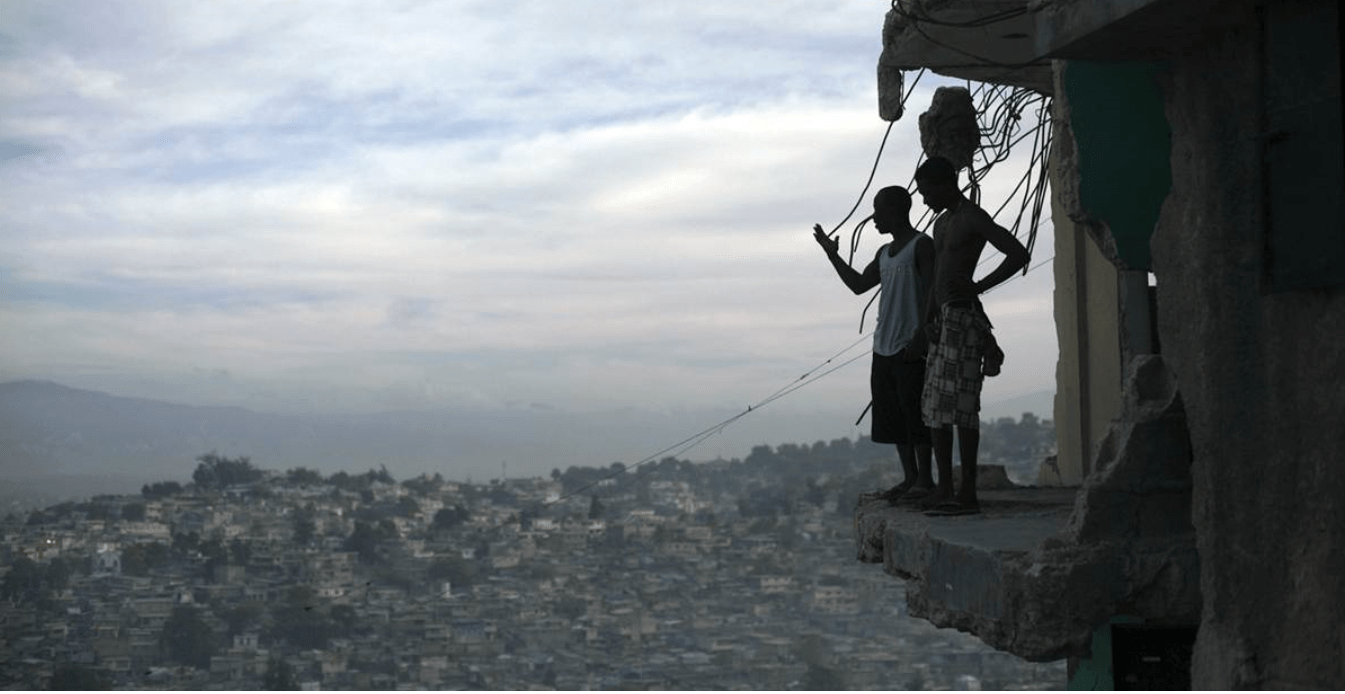
On June 1st I will be travelling down to Port-au-Prince, Haiti to intern with a social enterprise named Rebuild Globally, a four year old organization that has hired 21 local Haitian artisans to produce sandals out of recycled tires. Since I’ll be posting regularly during my time there, I want to set the stage by taking a deeper look at the context in which the organization is working, with the ultimate aim of setting up future discussions concerning the systemic and chronic issues the country faces on its long road to recovery and development.
January 12th marked the fifth anniversary of the deadly Haiti earthquake that killed over 230,000 people and injuring an additional 300,000. The images that emerged following the disaster were harrowing and captured the world’s attention, with any previous semblance of infrastructure and order in tatters.

Amidst the rubble in the aftermath of the quake.

Haitian women sit on rubble from a collapsed building in Port-au-Prince, Haiti, January 20, 2010.

Hundreds of thousands of Haitians lived in tent cities that sprung up after the earthquake. Today an estimated 80,000 Haitians have yet to find permanent housing.
The public outpouring of support in the aftermath of the earthquake was one of the largest in human history. Over 9 billion dollars in aid were committed to the recovery efforts, thanks to major celebrity appeals (Haiti “We Are the World” is a good example) and coordinated government efforts. Five years later, the rubble has been cleared from the streets, but Haiti is still feeling the repercussions of that day and the eyes of the world have moved on. How can we measure the wellbeing of the nation?
To get a better sense of where things stand today, lets look at some facts from the UN’s 2014 Human Development Index, an international ranking system which synthesizes country data on health, education and income levels. Haiti ranks 168th out of the 187 countries measured, placing it between Togo and Afghanistan. The average Haitian born today can expect to live 63 years, go to school for 5 years, and for the rest of their life their annual income will be approximately $1600. For comparison’s sake, a person born in 2014 in the US (which ranks 5th on the list) has a life expectancy of 79 years, will go to school for 13 years, likely receiving at least a marginal amount of college education, and from there can expect to make about $52,000 a year.
Comparing Haiti to the US is extreme, but even when compared to its neighbors in the Latin America and the Caribbean Haiti finishes dead last: Costa Rica ranks 68th on the list, Jamaica is 96th, and Ecuador is 98th. Haiti has the lowest human development index in the western hemisphere; the next lowest is Nicaragua and 132 followed by Honduras at 129 , 36 and 39 spots higher than Haiti. Perhaps the most striking contrast comes when comparing Haiti and the Dominican Republic, which share the island of Hispaniola. The DR comes in at 102nd on the UN report, 66 spots higher than Haiti, and a Dominican born in 2014 can expect to live 10 years longer, have 50% more schooling, and earn 6.6 times more money per year than a Haitian born that same year… staggering.

A map of Central America and the Caribbean. On the right side of the map, Haiti and the Dominican Republic share the island of Hispaniola.
The root of this disparity lies in Haiti’s French colonial past. Columbus originally discovered the island of Hispaniola on December 6, 1492 and claimed the island for the Spanish crown. Ultimately, as the Spanish discovered the mineral riches of Central and South America, they took little interest in the island and its relative lack of resources. Spain ceded the western part of the island to the French in 1697, who named it Saint-Domingue and imported slaves from West Africa to serve on coffee and sugar plantations, turning it into one of the most prosperous colonies in the New World. By the 1780’s, nearly 40% of sugar imported by Britain and France and 60% of the world’s coffee came from St. Domingue.At the same time, over 450,000 slaves were under the domination of 70,000 whites and freed blacks. Escaped slaves organized the only successful slave revolt in history, taking over control of the entire island by 1800 and declaring independence in 1804 and renaming itself Haiti. Years of warfare had destroyed the plantations that had made Haiti wealthy, and decades of political instability, military coups, and harsh dictatorships have ensued ever since. A new constitution was ratified in 1987 that called for an elected president and parliament, but corruption, UN interventions and repeated popular uprisings against political leaders have continued to this day. Current president Michel Martelly has delayed elections for three years, resulting in the dissolution of parliament and major protests in the streets of Port-au-Prince calling for his resignation.

Haitian protestors burn tires as they call for the resignation of current President Michel Martelly.
With all of this chronic political upheaval and economic uncertainty, how much did the earthquake of 2010 truly impact Haiti’s human development index ranking?” In the 2009 edition of the HDI, Haiti was ranked 149th out of 182, 19 spots higher than they are right now. In 2011, its rank dropped to 158th out of 187, mainly as a result of the damage done by the earthquake. However, that doesn’t explain why the country is 10 spots lower now, after 9 billion dollars of private and public aid have been spent on rebuilding the country. When you start looking into the data, Haiti’s life expectancy has improved since 2009 (63 years vs 61years) and so has average annual income ($1,600 vs $1,155).
The important conclusion we need to draw is that Haiti’s drop in human development rankings since 2009 cannot be attributed to the earthquake itself. Instead, there are underlying systemic issues that have resulted in other countries improving at a greater rate and overtaking Haiti in the rankings. Between 2009 and 2014, Senegal, Nigeria, Rwanda, Uganda, Zambia, Timor-Leste, Lesotho, Benin, Mauritania, Cameroon, Ghana, Sudan and Tanzania all passed Haiti… so the big question I will try to answer during my trip this summer becomes this: How must the strategy being used in Haiti to improve conditions for its inhabitants change in order to involve and empower Haitians to create a stable, secure and prosperous country?


 Aaron Danowski