
On a sunny California day in May, 2005, over twenty thousand people packed into Stanford University’s football stadium to listen to one of the brightest stars in Silicon Valley deliver his first (and only) commencement speech. Unbeknownst to them, by the time Steve Jobs and his family piled into their SUV in Palo Alto, they were running late. With his wife Laurene at the wheel and their three kids, Erin, Eve, and Reed in the back seat, Steve quickly went through his speech one more time, making final adjustments to his script as he went. He was tense, worried they weren’t going to make it in time.
When his family finally reached the stadium parking lot, a policewoman at the entrance was redirecting cars and telling them they needed to park in the overflow lot several blocks away. “You don’t understand,” Laurene explained, reading the doubt on the officer’s face. “I have the commencement speaker here. He’s right here in the car. Really!” Steve (dressed in an old black T-shirt, a pair of worn out jeans and a pair of Birkenstocks) didn’t quite strike the image of a commencement speaker, but the officer laughed when she realized who it was and allowed the family to proceed. They arrived just in time for Steve to put on his robe, gather himself, and take the stage.

Steve Jobs preparing for his 2005 Stanford commencement speech
Many observers consider the commencement speech Steve Jobs gave that afternoon to be one of the best speeches of the 21st century, and to date over 30 million people have watched it online. I first heard his talk in 2012, as I was wrapping up my senior year of high school and facing the daunting task of figuring out what I wanted to do with my life. Jobs’ stage presence, story telling ability and insightful commentary on the nature of life, death and meaning struck me, and I’ve routinely returned to his talk whenever I face uncertainty about my path in life. As I wrap up my 10 week stint here in Haiti and prepare for my next adventure in Cameroon, I decided to listen to Jobs’ speech once again, hoping his words would help orient me as I continue to pursue my calling.

As I listened to it this time, though, I took note of the three key lessons Steve Jobs drives home that have served as guideposts on my journey. I think they are vital lessons for anyone in pursuit of their calling in life, and they are as follows:
Steve Jobs’ 3 Lessons for Pursuing Your Calling
1. When you feel lost, trust that the dots will connect looking backwards
2. When searching for what you love, be persistent… don’t settle!
3. When making the big decisions in life, remember that one day you are going to die

Lesson #1: When You Feel Lost, Trust That The Dots Will Connect Looking Backwards
As Jobs walks up to the podium and launches into his speech, his opening statements revolve around the idea that life only makes sense in retrospect. He gives an example from his own life, citing a calligraphy class he decided to drop in on after deciding to officially drop out of Reed College:
“If I had never dropped out, I would never have dropped in on that calligraphy class, and personal computers might not have the wonderful typography that they do. Of course, it was impossible to connect the dots looking forward when I was in college, but it was very clear looking backwards ten years later. Again, you can’t connect the dots looking forward. You can only connect them looking backwards. You have to trust that the dots will somehow connect in your future… you have to trust in something, your gut, destiny, life, karma, whatever, because believing that the dots will connect down the road will give you the confidence to follow your heart, even when it leads you off the well worn path… and that will make all the difference.”
Jobs’ first lesson for pursuing your calling is trusting that the experiences in your life will connect. Once you do that, you are free to confidently live out the calling you feel on your heart, wherever it may lead you. I can attest to that: following your calling will take you places you never dreamed of. In the span of a year and a half, following my calling has taken me to India, Haiti and soon to Cameroon. I trust that I’m on the right path because I believe God is the one issuing my calling, and I know that as long as I heed that calling, it will lead me to the right opportunities and experiences that will shape the course of my life. That being said, I still struggle with questions and doubts about where I’m going.

On May 30th, two days before boarding my flight to Port-au-Prince, I penned myself a note in my travel journal that read “I don’t want to live a divided life, one where I constantly feel the pull of both my purpose and my home… I want them integrated. To do that I need to understand where to put down my roots: at home [in the developed world] or abroad [in the developing world].” Ever since returning from my trip to Chennai, India with the Opus Prize, as I’ve looked ahead towards my future after graduating, I’ve been split between two courses of action. In scenario one, I can see myself as an expat, working and living “in the field”, building relationships and raising a family. In scenario two I’m a consultant, a strategist working “behind the scenes” based in the US, Europe, or some other developed nation as my team and I support social entrepreneurial work around the world.
“Believing that the dots will connect down the road will give you the confidence to follow your heart” – Steve Jobs
Working in Haiti is summer has been my opportunity to explore scenario one and find out what expat life looks like, but it hasn’t helped me definitively chose one path over the other. Sometimes I wish I knew, wish that I could connect the dots looking forward, but then I realize that its the choice which makes life worth living. I long for confidence that I’m on the right path, when in reality the path is being created day by day, choice by choice. The only thing you can be sure of is that you’re making the best path you can make, striving to include your goals, dreams, values and talents as you surmount the challenges that arise as you go along.
I look forward to the day when I will look back and see how the twists and turns of the path I’ve made helped me achieve my calling, but for the time being I’ll enjoy the ride. With 10 weeks of living as an expat under my belt, I feel better equipped to make an informed decision when it comes time to choose my path.
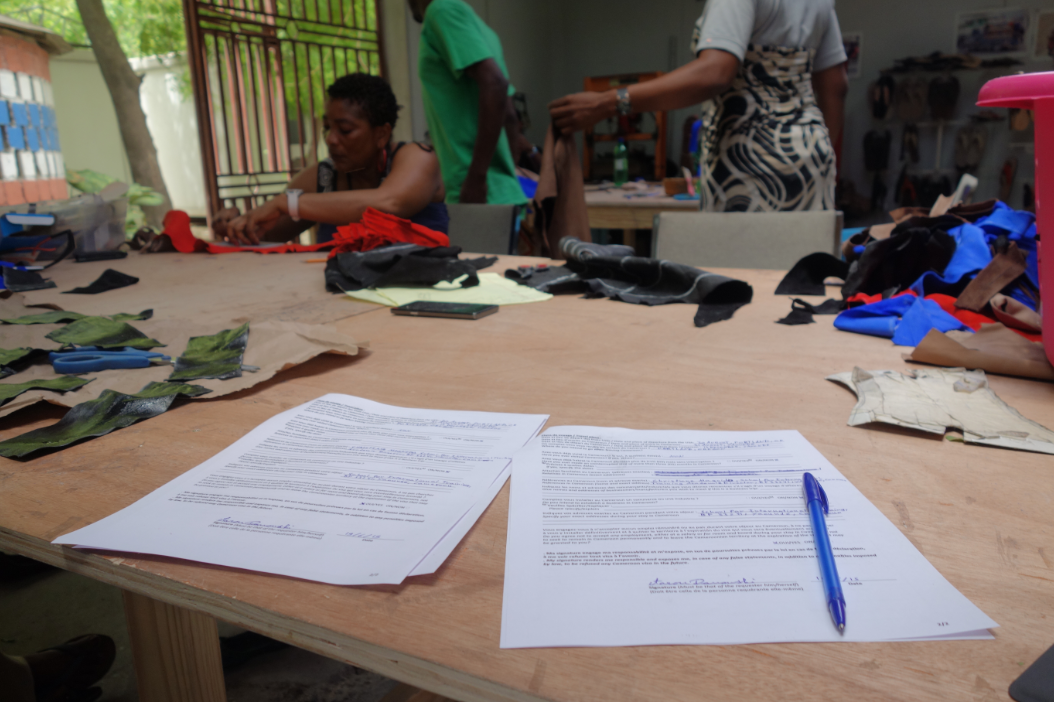
Filling out paperwork for study abroad in Cameroon
Lesson #2: When Searching For What You Love, Be Persistent… Don’t Settle!
After taking a quick swig of water to clear his throat and fight back the heat, Jobs launches into the second part of his speech, describing the importance of finding and doing work that you love:
“I was lucky. I found what I loved to do early in life… You’ve got to find what you love, and that is as true for your work as it is for your lovers. Your work is going to fill a large part of your life, and the only way to be truly satisfied is to do what you believe is great work. And the only way to do great work is to love what you do. If you haven’t found it yet, keep looking, and don’t settle. As with all matters of the heart, you’ll know when you find it. And like any great relationship, it just gets better and better as the years roll on. So keep looking… Don’t settle.”
I believe everyone has a calling, a purpose that they have been equipped to fulfill through their lives, and its important to align your career with that calling. Whether you pursue a career in the sciences, business, engineering, social work, teaching, writing, acting, music, or another field, your career helps you fulfill your calling when you use your talents and abilities to serve and empower others. As an example, I know that I want to use my business knowledge to advance the fields of social entrepreneurship and social business, creating a world where organizations profit as a result of helping people maximize their potential, rather than as a result of taking advantage of people. I want to be a part of the movement that helps businesses become agents for social change.

Many people find that to be an unconventional goal as a business major, but its because I see a future in which people don’t start businesses to make huge amounts of money, but rather to make the world a better place. I agree with Pope Francis’ assessment in the Evangelii gaudium, where he writes that “Business is a vocation, a noble vocation, provided that those engaged in it see themselves challenged by a greater meaning in life; this will enable them truly to serve the common good by striving to increase the goods of this world and make them more accessible to all.” (203.) Francis, an outspoken critic of “unfettered capitalism”, understands the need for change. The way businesses currently operate, with all the focus on quarterly earnings and stock prices, doesn’t take into account the tremendous harm being done to the environment and the workforce in the name of maximizing shareholder satisfaction. And Francis also sees that the way to change the system is to push the participants to unlock the deeper meaning of their work. Business can be a tremendous force for good, providing people with dignified jobs, livable wages, protecting the environment, and satiating people’s higher needs for self-actualization and fulfillment… but only if we choose to make it so. That is a mission I want to spend my life advancing.
Business can be a tremendous force for good… but only if we choose to make it so
The key to doing great work is to ensure your job allows you to pursue your calling. Many people separate the two, assuming that you need to work to pay rent and to allow you to volunteer and pursue making a difference in your spare time. You cannot settle for this scenario. To do great work, you must believe you are making the world a better place because of your work. Remember, “Your work is going to fill a large part of your life, and the only way to be truly satisfied is to do what you believe is great work. And the only way to do great work is to love what you do. If you haven’t found it yet, keep looking, and don’t settle.”

Lesson #3: When Making the Big Decisions in Life, Remember That One Day You Are Going to Die
As Steve Jobs pauses for a second and surveys the crowd, he launches into the third and most compelling part of his speech: the value of death and dying. Every morning for the past 33 years, he says, he looks himself in the mirror and asks “If today were my last, would I want to do what I am about to do today?”. If his answer is no too many times, he knows something has to change. He goes on to say that “Remembering that I’ll be dead soon is the most important tool I’ve ever encountered to make the big choices in life. Because almost everything, all external expectations, all pride, all fear of embarrassment and failure… these things just fall away in the face of death, leaving only what is truly important. Remembering that you are going to die is the best way I know to avoid the trap of thinking you have something to lose. You are already naked, there is no reason not to follow your heart.”

Half-finished coffins in Port-au-Prince
Take a moment and think of a time you decided not to do something because you were afraid of failing. Really think about it. Got something in mind? Now read that quote again:
“Remembering that I’ll be dead soon is the most important tool I’ve ever encountered to make the big choices in life. Because almost everything, all external expectations, all pride, all fear of embarrassment and failure… these things just fall away in the face of death, leaving only what is truly important. Remembering that you are going to die is the best way I know to avoid the trap of thinking you have something to lose. You are already naked, there is no reason not to follow your heart.”
This is perhaps the biggest lesson for pursuing your calling from Jobs’ speech. Lots of people choose to mortgage their calling en lieu of stability, comfort, and security. Other people are so afraid of rejection or failure that they never bother even trying to pursue their calling. Still other people feel like it would require too much unconformity or too much effort to orient their lives and their careers around their calling. All three excuses (stability, fear of failure and too much effort) go out the window when you think about death. When you are on your deathbed, surrounded by your children and your grandchildren, will you be thankful for the stability, grateful for having avoided failure, or happy in the fact that you didn’t push yourself too hard? Or will you be at peace, knowing in your heart that you did everything humanly possible to make a difference and live up to the calling you felt on your life?
“Remembering that you are going to die is the best way I know to avoid the trap of thinking you have something to lose” – Steve Jobs
No matter where you are in life, it’s never too late to choose to pursue your calling. The world needs passionate men and women, grandparents and grandchildren, sons and daughters who are not afraid to trust that the dots will connect, who pursue doing great work, and who live each day as if it were their last. You never know, you may be surprised by the greatness within you.
– – – – –
Steve Jobs’ 3 Lessons for Pursuing Your Calling
1. Trust that the dots will connect when you look back on your life
2. Be persistent searching for what you love… don’t settle!
3. Remember you are going to die when making the big decisions in life
– – – – –
This is my last post from here in Port-au-Prince. The next time you read an update from me, I will most likely be settling in to my semester abroad in the West African nation of Cameroon. I want to leave you with one final thought, a quote from a former Opus Prize winner named Lyn Lusi about pursuing your calling:

Lyn Lusi, Co-Founder of HEAL Africa
“Ask yourself, where in the world is it that God wants me to be working? In every one of us called to be His follower, God will put into our hearts a passion for justice — to fight for justice for a segment of His people through the high calling that we receive. It will not be the same call for everyone, and it might be completely different for you and for me. But God has a vision for our lives — that’s His job — and he sees a lion inside of us that He wants to set free. I urge you to set your lion free, and follow God’s high calling for your life.”
– Lyn Lusi, 2011 Opus Prize Grand Winner
Trust that the dots will connect, don’t be afraid to forge your own path, and don’t settle for anything less than living out your calling.
– Aaron D

– – – – –
Thanks for visiting aarondanowski.com! Leave you comments below, and be sure to stay up to date on my travels by clicking on the “Following” button on the right hand side of your page!
If you would like to contact me directly, please do so via email: adanowski@zagmail.gonzaga.edu


 Aaron Danowski
Aaron It’s hard to believe your time is almost over…, I just returned from Argentina (visiting ben’s family) and now I’m in Williston, ND to meet the students that have done internships here.
I am reading the purpose economy. What a great book. Thank you so much for telling me about it. I’m going to be using this for my leadership team retreat next week.
Thanks for keeping in touch. Judi
Sent from my iPhone
LikeLike
Its crazy, I agree Judi, although I’m quite glad to have some time at home to gather myself and prep for Cameroon! I’m glad you’re liking the Purpose Economy, its a really insightful read! I hope you had fun in Argentina, and hopefully the leadership retreat goes well this weekend! By the way, my student team for AshokaU has a few updates for you on the work they’ve been doing this summer, so just a heads up!
LikeLike
It’s too bad I didn t get to see you before you left. Great Blog!
LikeLike
Sorry Reg! It was awesome getting to know you man, all the best moving forward! And thanks, I’m glad you enjoyed the blog!
LikeLike
Great post, Aaron. Thanks for the inspiration. You have many talents and gifts – thank you for sharing them.
LikeLike
Pingback: “What Now?”: Final Lessons from a Semester Spent in Cameroon | Aaron Danowski