
This past weekend I bought a ceramic art piece made my some students in Cameroon’s only professional arts school, located in a city outside of Yaounde called Mbalmayo. Take a look at it below (It’s about 10 inches wide and 6 inches tall). The artist uses toned dust and locally sourced Cameroonian clay to depict three Cameroonian children admiring a sunset, as a flock of birds fly towards the mountains in the distance
Take a second to look at it… What do you see?
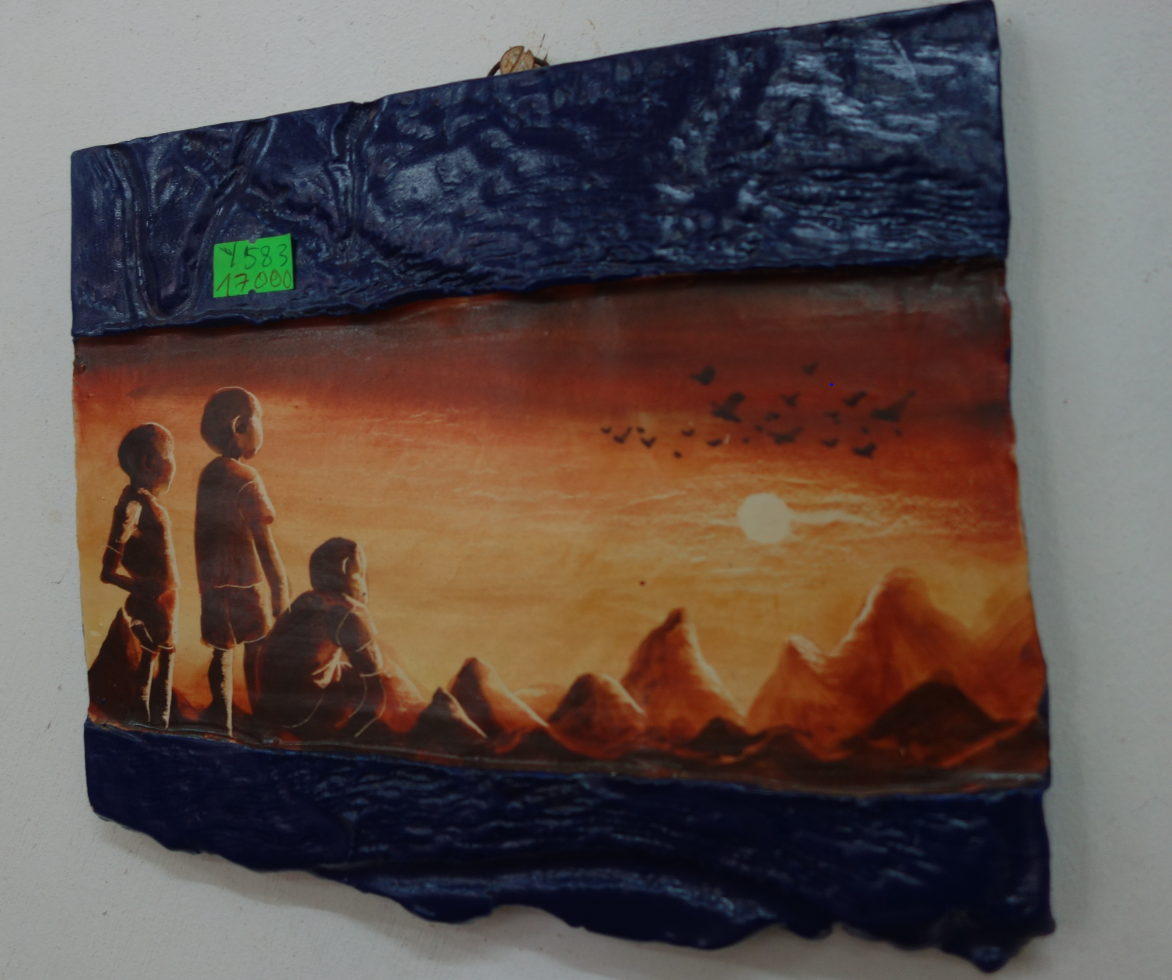
When I first came across it in the studio, I saw three Cameroonian youth envying the birds. Unlike the children, the birds were able to easily escape their environment and find greener pastures beyond the horizon.
I circled back to this piece three times to admire it, each time spending a few minutes analyzing the composition and the meaning of the piece. The third time around, SIT Cameroon’s program director, Christiane, came over beside me and remarked how much she liked the piece. I asked her what she saw. As soon as I heard her reply, I immediately took it off the wall and rushed over to the counter to buy it.
– – – – –
One of the major themes we’ve been discussing in class is the idea that there is not a “one size fits all” path to development. The path to wealth in the US and Europe isn’t necessarily the path to wealth for Africa and Latin America. Successful development is more than economic growth at all costs; it’s culturally appropriate economic growth. Successful development doesn’t mean creating copies of “America” around the world and helping countries “westernize” by adopting American values. It involves helping countries create jobs and transform natural resources while respecting cultural differences and preserving local values, beliefs, and traditions that provide people a sense of identity and community.
Successful Development = Culturally Appropriate Economic Growth
Let me give you an example: In the US, one of our core societal values is the idea that “I am my own person”, that our identity is individualized and self-made. In contrast, Fr. Patrick Baraza (a Kenyan professor at Gonzaga) teaches his students that one of the bedrock values of African traditional communities is community identity, the belief that “I am because we are”. This is the clash between American individualism and African traditional communalism. The key thing to recognize is that, objectively, neither of these values is inherently “better” than the other. They both have their merits: individualism encourages personal achievement and innovation, while communalism stresses strong relationships and cooperation. However, people are hardwired to believe that their culture is better or more correct than other cultures, and as such they seek to replace alternative ideologies with their own, a phenomenon referred to as ethnocentrism.
International development experts from developed countries often inadvertently make the mistake of not recognizing their ethnocentrism when they work in different cultural contexts. In doing so, they place too much emphasis on the economic growth portion of “successful development”, at the expense of the “culturally appropriate” portion. It’s the reason why the period of “structural adjustment loans” undertaken by the World Bank and the IMF in the 1980’s proved so disastrous. According to the program, countries that applied for development aid from these organizations had to meet certain benchmarks of economic reform, specifically privatizing state-held assets, cutting government spending, decreasing taxes, and increasing access to foreign capital, all things that were “working” in the developed North and which were thought to be the key to developing the global South. Ultimately, the program failed because it was not culturally appropriate in the countries it was working in. Politically centralized leaders sold state assets to cronies and political allies, the cuts in public spending led to an explosion of NGO activity to fill in the gaps, and local industries that relied on government assistance such as national banks went out of business, allowing multinational companies to enter the market and further create dependency on the developed American and European countries.
The key takeaway from the failure of the structural adjustment plan is that successful development is very difficult for outsiders to direct, since it requires more than just economic knowledge. If development is ever going to succeed, there needs to be a marriage between economic policy and cultural knowledge. Development leaders must have a deep, personal understanding of their society’s hopes for the future, valued traditions, worries about development, and deeply held beliefs. Yes, international economists and development experts have a role to play in development, but they must realize that oftentimes that role is to recognize their ethnocentrism and allow local ownership of development to take hold. If they truly care about development, once they’ve acknowledged their cultural bias, well intentioned foreign experts will adopt a servant leader approach and choose to limit their involvement, allowing young, passionate local leaders to craft culturally-appropriate development goals for their countries.

– – – – –
Flash back to the scene where I’m standing in the art exhibition showroom, admiring the ceramic painting of the three children watching birds fly towards the mountains into the sunset. What did Christiane say that pushed me to to buy the piece? Rather than seeing the children as helpless prisoners of circumstance as I had, she saw them as empowered future leaders of Africa, coming together as a community to enjoy the beauty of their homeland. Christiane’s response showed me my ethnocentrism, and reminded me of how important it is to acknowledge my cultural bias before pursuing culturally appropriate international development:
“I see three intelligent children who, at the end of a long day, have come together to admire the natural beauty of their country. I think it’s the best piece in the shop, good choice.”
– – – – –
Thanks for visiting aarondanowski.com! Be sure to stay up to date on my travels by clicking on the “Following” button on the right hand side of your page!
Leave you comments below, and if you would like to contact me directly, please do so via email: adanowski@zagmail.gonzaga.edu


 Aaron Danowski
Bravo!!! I Love hearing the thoughtful reflections on your new environment and the ‘visionary’ learning you are doing.
LikeLike
A post that touches the mission of “the sower”. Plant the seed Son. Love Dad
LikeLike
Buen trabajo Aaron! Muy interesante !
LikeLike
I’m glad you’re safe and sound & enjoying your semester there, Aaron. Keep up the great attitude & work, lots of love,
Mark
LikeLike