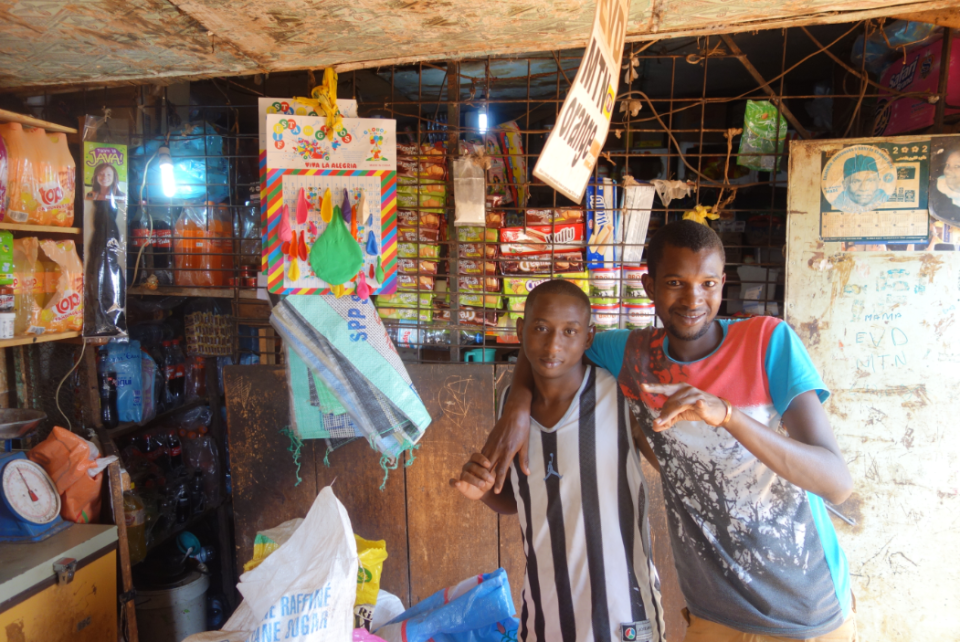
What would you do to provide for your family? Travel thousands of miles? Risk your life navigating terrorist-occupied forests or the bone dry Sahara Desert? Spend three months in prison? Go years without seeing them? Abdoulai (below,left) and Kaladou (below, right) not only would… they have.
In one of the most heartbreaking and vulnerable exchanges of my life, I spent two hours listening to the stories of these two 28 year old Senegalese men who have risked their health and safety again and again for the sake of their loved ones back home… with no end in sight. When I dropped by the cornerstore down the street Saturday afternoon to say goodbye to Abdoulai, they gave me a free bottle of Coca Cola and allowed me to step into their shoes and see life from their perspective, and their stories rocked me to my core…
He finally decided to take the risk , so he picked up his things and left. After two weeks spent trekking through the Sahara desert and watching those around him die of thirst and exhaustion, Abdoulai peered over the bow of the boat full of migrants traversing the Mediterranean and saw the blurry lights of Italy on the horizon. They were distant, but for a second, they shone with bright potential of a new life, a life that promised economic stability. But it only lasted for a second, because soon after that, the Abdoulai’s boat was caught by the Italian Coastguard and was sent back to Libya. Upon being offloaded in Tripoli, Abdoulai and his fellow migrants spent three months in a Libyan prison, being beaten by the security guards, and being given minimal food and water before ultimately being let loose in the desert and told to go home. After returning to Cameroon for a short time and saving up his money, Abdoulai made a second attempt to make it to Italy, traveling to Lake Chad in the Extreme North of Cameroon and paying smugglers to help him reach Libya. That time, his boat successfully made it to shore in Italy, only to have the migrants apprehended by local authorities and sent back to Libya. Since then, Abdoulai has searched unsuccessfully for full-time work in Senegal, Benin, Nigeria, and Cameroon that can support his parents and elder brothers back in Senegal, but all he has managed to find is his work at the cornerstore that barely pays enough to send anything back at all. Ultimately, he finds it better to save up his money to try and make it to Italy a third time. He understands the risks, but the reward is too much to turn down: “You see two boats leave, one capsizes and everyone in it dies, but you keep going, that’s how it is… When you go live in Europe and have your papers in order, you can come back and visit your friends, but when you only spend your life in Africa its not good, you won’t have anything, just difficulties.”
For Kaladou, his journey started in 2001 at the age of 15, when he left to find work in Morocco for 5 years to provide for his widowed mother. When he returned with approximately $1300 , his uncle took it all and sent him to the Congo where he found work as a dishwasher for 6 months and did odd jobs for another 2 ½ years before returning to Senegal. Once back, he married and had three children (“their names are Tijang, Saidou, and Fatima”, he tells me), and he worked for 4 years to provide for his growing family with limited success. Since 2013 he has been steadily making his way down the African coast seeking opportunities that earn enough money to send back to his family. Recently, a smuggler that promised to take him from Senegal to Yaounde left him stranded in Nigeria, and when he called his uncle asking him to pay back some of the money he had earned, he refused. After three months working odd jobs in  Nigeria, he managed to scrape together enough money to join a group trekking across the Nigerian border. On their journey through the forest, he told me they came across corpses, victims of Boko Haram, laying strewn on the ground. They lived in fear for several days, afraid that they would be next. Luckily, he made it safely to Yaounde, and how he is working as a shoe repairman and sending back what he can each month (he showed me the remittance transfer for November: 20,000 CFA, about $32). His ultimate goal is to save up and reach Equatorial Guinea. “They treat people very poorly over there” he tells me, “but we’re obligated to go. If that’s where I can earn a living. When your kids call you and say “we need money for food”, and when your wife and your mother say the same thing… it’s a big problem… I leave for work at 6 am and get back at 6 pm, but you know when your kids are back there, your wife is back there, you can’t just shrug your shoulders, what are they going to eat? You have to fight, and if you find a little bit, you send it back.”
– – – – –
I was shell-shocked walking away from our discussion… these two friendly guys who I’d been saying hi to at the corner store for the past month were two of the most courageous, hardworking people I’d ever met, and both of their lives could very well serve as the basis for Hollywood movies. But the thing that struck me most about Abdoulai and Kaladou’s stories was that they highlight the imperative that exists for developed countries to acknowledge that the Mediterranean migrant crisis is not going away, and if anything, is only going to get worse. Both of these men have literally risked life and limb in pursuit of economic opportunity for themselves and their families, because they realize they no scenario exists where they and their children have a bright future when they are forced to migrate to merely scrape by. With the best population estimates expecting Africa’s population to make up 1/4th of the world population by 2050, its imperative to ensure Abdoulai and Kaladou’s children’s generation feels like they have a future in Africa… or else the entire world will suffer the consequences.
So what would that require? Well, given the fact that record numbers of refugees and economic migrants from Africa like Abdoulai are landing on the beaches of Europe seeking a better life, we need to examine what is forcing them to risk their lives in the first place. On the surface, the answer is easy: there is a lack of jobs in Africa, so people go elsewhere looking for work. Digging a layer deeper however, we find the root problem: Africa’s economy is based on the export of raw materials, such as timber, oil, rare earth materials (which power the technology industry), aluminum, and plantation grown fruits and vegetables,as opposed to the model the industrial world is built on, which is the transformation of raw materials (creating rubber, steel and concrete and producing computer chips and building airplanes). This phenomenon is clearly visible in the Food and Agriculture Organization of the UN’s 2014 “State of the World’s Forests” report, which shows that Africa is the only continent where primary materials make up the bulk of the economic value added by forests. Every other continent derives most of their forests’ economic value from processing industries… and the contrast is stark:
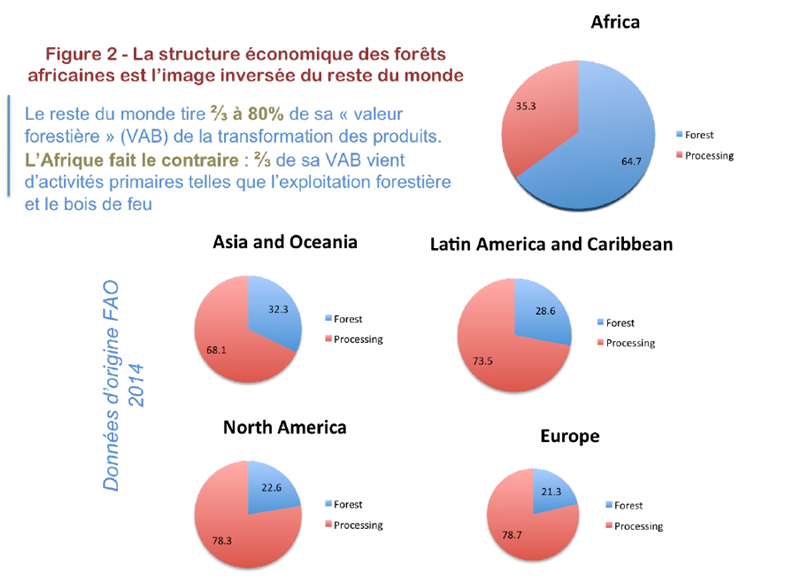
Source: Les Communautes de Pratique Forets Modelles: Pour un Basculement du Paradigme Participatif dans L’economie Sociale et la Transformation Structurelle, by Diaw MC, Nguiebouri J., Gagoe Tchoko J., NgoBaneg MF., Vambi B., Nlend E. and Keugni MC.
In more concrete terms, this means that, while a tree that is cut down in Cameroon creates a job for man or woman selling charcoal, or the person exporting the tree out of the country, a tree that is cut down in the US creates a job for the logger, the truck driver that transports the tree to the processing plant, the workers at the lumber plant that transforms the tree into two by fours, another truck driver who delivers the lumber to Home Depot, the guy at Home Depot in charge of the lumber department, and the construction worker who buys the wood and uses it to build a house… not to mention a job at the EPA to ensure the logging company replants trees after logging!
This layered transformation of raw materials is called a value chain, and the lack of value chains in Africa extends to most raw material industries here in Cameroon and in other sub-Saharan African countries, which makes stories like Abdoulai’s and Kaladou’s all too common. In a way, its kind of our fault… Under the current global economic system, its implicitly understood that stories like Abdoulai and Kaladou’s are “collateral damage” in the process of ensuring that the US and European countries can exert their control over African raw materials and transform them themselves, rather than allowing local African industries to develop and buying finished products from Cameroon, Namibia, or Tanzania.
If we are serious about ending the migrant crisis and reducing the number of human tragedies like the ones witnessed off the coast of Italy over the last several years, we need to realize that true African development can only happen when local value chains and industries develop that transform raw materials and create employment and wealth in sustainable ways that stay in Africa. Even if a multinational company like Firestone comes to a country like Liberia and employs some local people to work on a rubber plantation, or an international logging company employs some Cameroonians, the economic value of those resources is still being drained out of the African context… which contributes to the cycle of poverty and underdevelopment. As Dr. Mariteuw Chimere Diaw, a Senegalese PhD holder running a social enterprise called Africa Model Forest Network here in Yaounde explained to me several weeks ago:
“The mining industry, the forest industry, they are totally oriented toward exporting raw material. When you look at it, people [are] investing a lot [of energy] into issues of rights and deliberative democracy, formal democracy, all kinds of democratic things, but the economy is too weak, so people jump into the sea to cross the ocean, so what is your democracy bringing to them?”
– – – – –
So what concretely can be done to resolve this problem, to restore Africa’s future? One thing is for sure: the solution is not more development aid from the US and other developed countries. Aid money does not address the root cause of the economic problems Africa faces. Development aid is the token solution that conveniently produces some feel good stories and impacts a few people, but it distracts from the root of the problem, which is the global economic system that is skewed by political maneuvering to favor the most powerful countries in the world. Its why populist leaders like Mossadegh in Iran, Arbenz in Guatemala, Allende in Chile, Roldos in Ecuador, Torrijos in Panama, and Lumumba in the Congo, who refused to cede to Western interests, met with untimely fates. Whenever a new government takes power in a country rich with raw materials, they know they must tread a fine line between appeasing the powers that be by granting them access to raw materials and looking out for the best interests of their people… and development aid projects often serve as a nice compromise.
But there is some good news: See, since the issue is economic at its core, that means it is a system driven by the everyday purchases we make as consumers. As such, we can consciously choose to fight against the systemic violence and exploitation that currently ravage the African continent and produce stories like Abdoulai’s and Kaladou’s. We have the power to contribute our voice to the chorus calling for an economic system that provides opportunities for people like Abdoulai and Kaladou. One of the best ways to do so is by buying products made by local cooperatives and social enterprises in developing countries, rather than the big companies that don’t invest in jobs and production facilities in these communities. Here are a few examples (perfect for you last minute Christmas shoppers!):
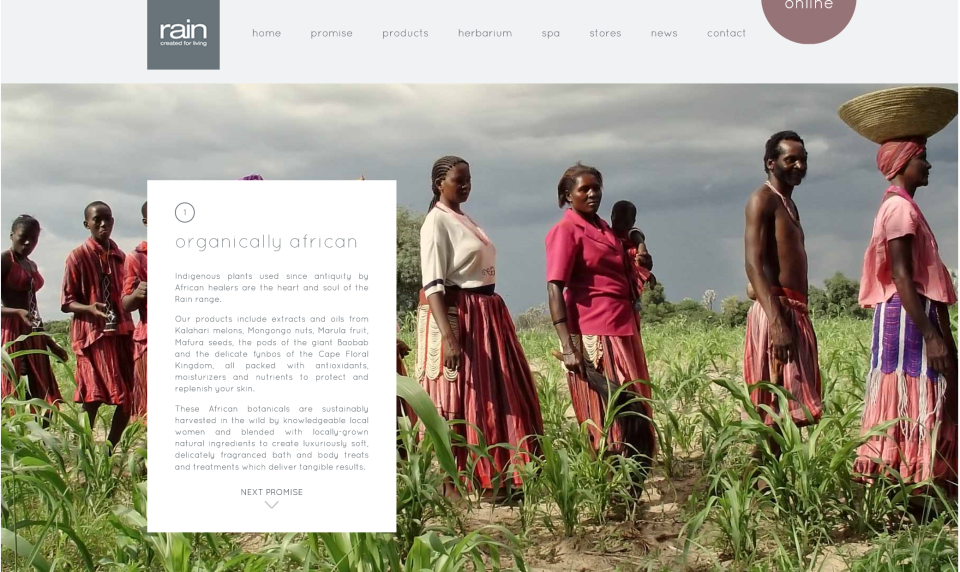
Want some bath or beauty products that support local economies in Africa? Check out Rain Africa, a South African organization with a commitment to “provide jobs, skills and hope to people living in desperate poverty, particularly women and the disabled. Our production cycle is deliberately low-tech and labour intensive. Our products and packaging are hand-made by trained crafters. We support small local suppliers and producers. Our wild ingredients are hand-harvested by women living in remote areas of Southern Africa where economic opportunities are almost non-existent. We are the only Southern African beauty and body product company which is accredited by both Fair Trade in Africa and the international Fair Trade body in Europe.”
– – – – –
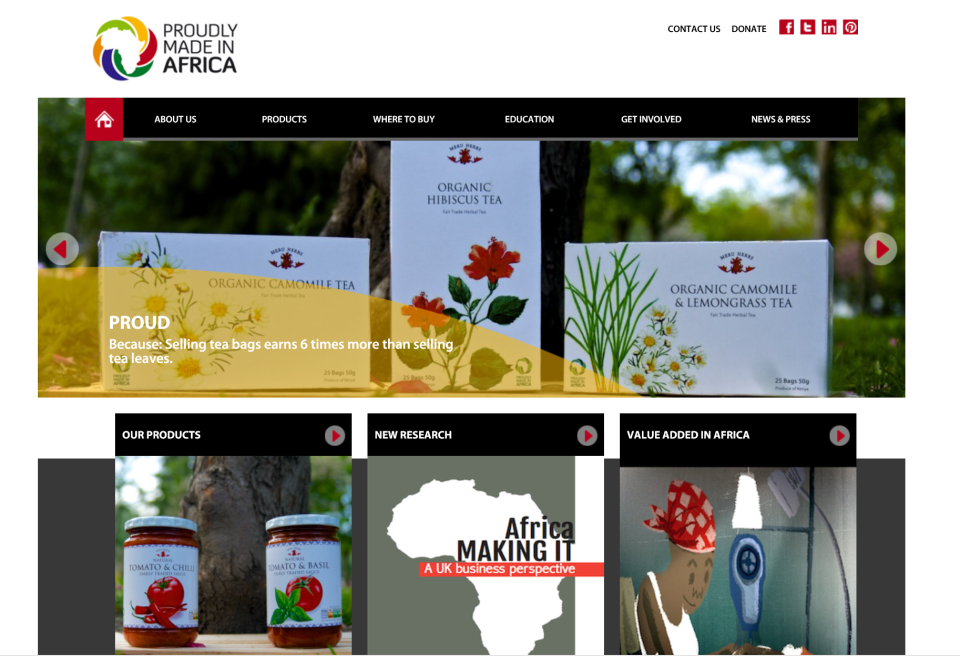
Another organization, “Proudly Made in Africa“, identifies and exports high quality finished African products to European markets, but many of the products they promote (from coffee, footwear, and jams to garments and beauty products) can be searched and bought online via this page on their website. You can also check out a short animation below produced by a Kenyan production company detailing their business model!
– – – – – –
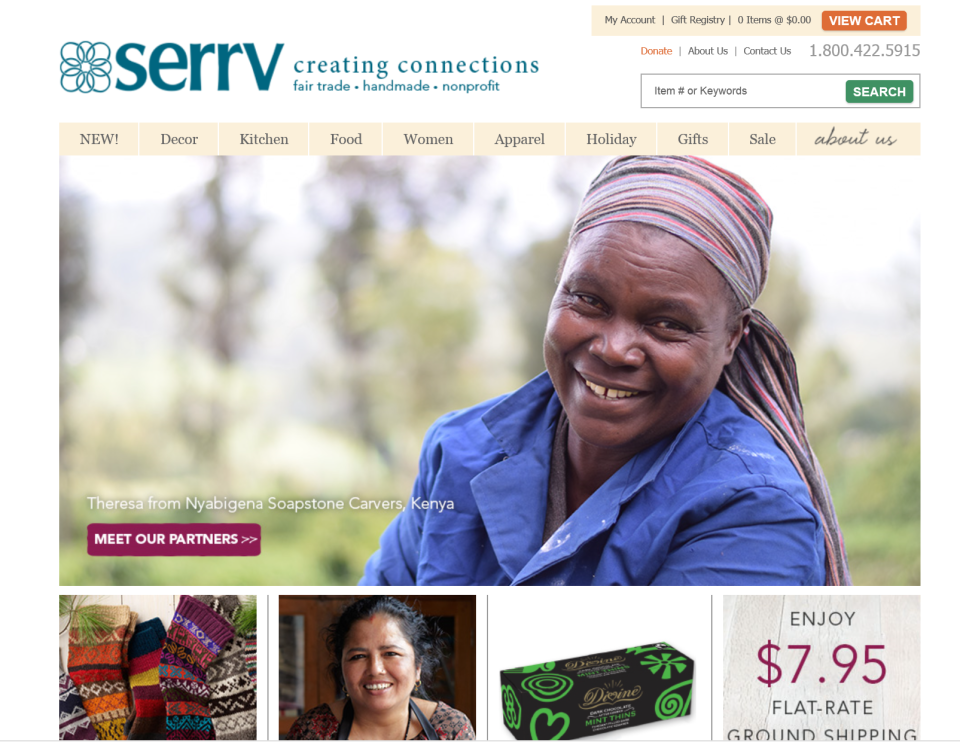
And finally, for an even greater selection of products from cooperatives and local communities around the world, check out Serrv, a nonprofit fair trade organization that proudly believes that “disadvantaged artisans and farmers around the world should have the opportunity to break the cycle of poverty and support their families through fair payments and respectful relationships. Every basket, every tablecloth, every necklace we offer has a story behind it–of an empowered artisan or farmer who works in a safe environment, can send his or her children to school, and can save for the future with the reliable income he or she earns through fair trade.”
– – – – –
While those actions support the initiatives that have already started, lots of work needs to be done on the legislative side to incentivize large companies to invest in local production facilities rather than simply exporting raw materials to be transformed in China or the US. Maybe one day you’ll order a smartphone by the Kenyan version of Apple, or the “Dell” of Cameroon… but that may be too optimistic given the number of international institutional reforms that would need to take place to provide space for such organizations. Whatever the case, it’s only a matter of time before the current (dare I say neocolonial?) economic system is forced to undergo some massive readjustments, as Dr. Chimere expressed to me in our meeting:
“There is a struggle between the old ways of producing wealth and [the] need to do it differently. And that is going to be discussed a little bit in Paris, at COP 21, and we’ll see what comes out of it, but fundamentally, to me, the discussion and the stakes that are behind it are the stakes about the new economy… it’s not conceivable that Africans will just remain poor, they’re too wealthy, you know, with their environment, all the natural resources, all the untapped wealth that exists for this to continue forever. But whether it’s going to be slow, whether we’re going to control it or whether some other entity is going to control most of it, that has yet to be decided… I do believe that there is room for a collaborative economy that isn’t going to be one dimensional,[but] it’s going to have very different ways of existing, of emerging. It has already started, but a lot will be decided by the way Africa is going to catch up.”
Hopefully that economy will develop in time for Kaladou’s children, Tijang, Saidou, and Fatima, to know they have a future in Africa.
– – – – –
Thanks for visiting aarondanowski.com! Leave you comments below, and be sure to stay up to date on my travels by clicking on the “Following” button on the right hand side of your page!
If you would like to contact me directly, please do so via email: adanowski@zagmail.gonzaga.edu

 Aaron Danowski
Excellent post…I learned so much. Thank you!
PS. When will you be returning?
LikeLike
Great post, Aaron! You are touching lives all over the world, and educating so many of us about the global ‘systems’ currently in place and the impacts of such. I think including the links to local African products is inspirational, thanks so much for taking time to share your experiences and thoughts with us. And I can’t wait to see you in just over a week!!!!
LikeLike
Hi son, Dad here. I could not be prouder… what a great post. It is always a small miracle when you make a connection with the lives around you… specially in circumstances that would normally be overlooked. For you, Dylan Thomas said it best ” and you, my father, there on that sad height, curse, bless me now with your fierce tears, I pray. Do not go gentle into that good night. Rage, rage against the dying of the light.” And you have… and you shall. Come home soon.
LikeLike