
Over the last two weeks, the world witnessed the largest coordinated act of civil disobedience against the fossil fuel industry in history. Over 30,000 people across six different continents took part in the “Break Free” movement, which is calling for “the rapid, just transition from the fossil fuel economy of the past to the 100% renewable and clean energy future that climate justice demands.” This movement manifested itself through acts of civil disobedience and mass protests at twenty epicenters around the world. For example, over 2000 protesters in Newcastle, Australia shut down the world’s largest coal port on May 8th:
In Germany, 3000 people from all over Europe shut down the Vattenfall coal mine in Lusatia over three days of action May 13th-15th:
On May 4th, 10,000 people marched in Batangas City in the Philippines demanding the cancellation of plans to build a 600 megawatt coal plant in the area. Thousands protested against fracking in the state of Parana, Brazil on May 9th, and other “Break Free” actions took place across Nigeria, South Africa, Indonesia, Turkey, and the US.

Via:breakfree2016.org

Via: breakfree2016.org
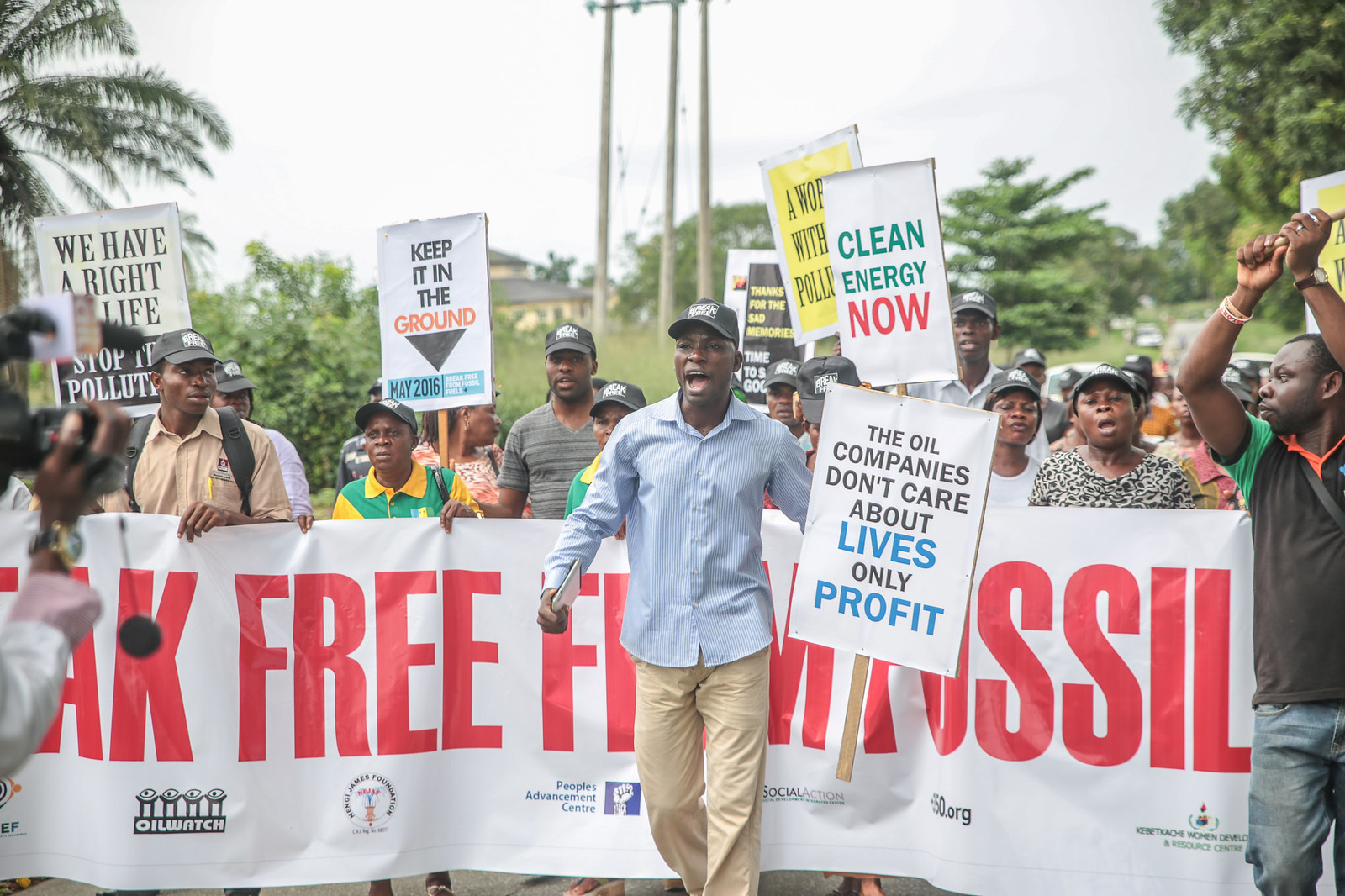
Via: breakfree2016.org
I was lucky enough to participate in this historic movement right by travelling up to Anacortes, Washington from May 13th-15th to join hundreds of activists from across the region to protest outside the Shell and Tesoro oil refineries in Anacortes. These two refineries represent the largest source of carbon emissions in the region, and combined they supply 47% of the fuel used in the Pacific Northwest. Hundreds of us participated in an Indigenous Day of Action, marching three miles calling for a just transition from fossil fuels to renewable energy, as well as an increased ability for Native Americans to preserve their heritage and practice their traditional way of life. The land the refineries are built on belongs to the Samamish people, and powerful community symbols such as the clams and crabs that live in the area have become too toxic to eat, thanks to the pollution emitted by the refineries 24 hours day, 7 days a week, 365 days a year. The march was intended to be a show of solidarity for the indigenous communities that are struggling to have their rights respected by profit-hungry companies like Shell and Tesoro.
Several dozen protesters were arrested at a separate event on Sunday, when they blockaded the railroad tracks that oil trains use to reach the refinery, but I decided not to participate in that. Nonetheless, I felt privileged for having had the chance to participate in this event, and for being surrounded by hundreds of passionate, dedicated climate activists, young and old.

As news of other Break Free events worldwide trickled into the group, and as the activities wrapped up on Sunday after the police crackdown on the railroad blockade, I was reminded that we are all engaged in a common struggle. The issues the climate justice movement in the US are fighting against are the same ones that groups are facing worldwide. Corporate power and capitalist profit-seeking is hurting indigenous, marginalized communities in Cameroon, India, Washington State, and beyond. Extractive industries such as coal, oil, and gas are creating harmful amounts of pollution in North Dakota and Pennsylvania, just the same as they are in Nigeria, Australia, and Indonesia. And ultimate, the biggest takeaway from the weekend was just how much we have to learn from indigenous communities who have successfully lived in harmony with nature for millenia. I wrote the following in my journal Saturday night:
“The indigenous flute player at dinner tonight told a story about his grandmother, when his mom was little, going down to the river before her kids took a bath, placing her hands in the current, and praying the following prayer: ‘O sacred water, we have not come to desecrate you. We ask you to give us your strength and to keep us well and strong. We honor you.’… Imagine how different our world would be if we approached the mundane activities in our lives with such reverence, intentionality, and recognition of the inherent value of nature. This is the complete antithesis of using seven million gallons of water to frack an oil well in North Dakota, transporting it to Oklahoma, pumping it into underground storage tanks, and coping with the multitude of earthquakes that is the result… Lord help us, we know not what we do.”
Ultimately, the only way to address the issue of climate justice is to humble ourselves and learn from the wisdom of those we have exploited for so long: indigenous people and women. If we are able to do that, we can create a transnational global people’s movement that can save our planet from the extractivist, dominator complex our society has embraced since the Age of Exploration 400 years ago.
– – – – –
There’s just one big problem impeding us from reaching this global consensus: While the issue of global warming and climate justice is seen as a very serious issue in some places, especially by indigenous communities and citizens in the Global South, it is still seen as a fringe issue here in the US and in the Global North. The North-South divide on this issue is painted quite clearly in the Pew Research Center’s 2015 Global Attitudes survey, which asked 45,435 people across 40 countries to rate their level of concern about the personal toll climate change would have on them. The average level concern was found to be much greater in developing countries than in industrial, developed countries:

Why such a big difference? Part of the difference may boil down to the fact that people only consider the direct impact of climate change on them, rather than the indirect impact it may have. This means places where a greater percentage of their population works in agriculture, such as Brazil (15.7%), Peru (25.8%), Kenya (75%), and Uganda (82%) are more likely to consider themselves at greater risk of being directly affected by changing weather patterns. Conversely, people living in more service-based economies where less people work in agriculture are less likely to be directly affected by weather pattern changes. This includes places like the US (0.7%), the United Kingdom (1.3%), and Australia (3.6%) (Percentages from the CIA World Factbook).
Ultimately, however, citizens in service-based economies ought to be just as concerned as people in agriculture-based economies, since the indirect impacts of climate change on their lives promise to be incredibly severe. For one, people in service based economies buy food that is grown internationally and imported. In addition, much of the agriculture in service-based economies is highly industrialized, which means it relies more heavily on fossil fuels and chemical fertilizers than less industrialized, subsistence farming in the Global South. This means that, as the world warms up and as countries begin to take action to decrease their carbon emissions, developed countries will be required to rethink the way they approach agriculture, which will drastically affect all citizens living in these countries.
Ultimately, I think most people in developed countries are in denial. If the climate is indeed warming, and if human beings are deemed to be the main culprit, then a person in the US has more to lose than a subsistence farmer in rural Uganda or Peru. Energy- and carbon-intensive lifestyles will quickly become impossible to maintain if serious efforts are taken to mitigate climate change and transition away from fossil fuels. People will be forced to live in smaller houses that use less energy, or in more concentrated urban apartments that require less travel to get places. Public transit will need to replace automobile culture, energy usage could be rationed, especially during peak consumption times in the evenings and during the summer (air conditioning) months. Local, seasonal foods would be available at local supermarkets/ farmers markets, not the panacea of exotic fruits and vegetables available in Safeway and Walmart year round. In addition, meat consumption would need to drop considerably in order to maximize the productivity of farmland for human consumption. All of these changes in lifestyle provide plenty of reasons for the average US citizen to want to believe climate change isn’t real, that it isn’t a serious problem, or at least that it won’t affect them personally.
I believe it’s only a matter of time before everyone starts waking up to the reality that climate change will affect them personally. But it’s up to the climate justice movement and those who are already being affected, like the Indigenous communities in Anacortes and around the world, to make their voices heard and sound the alarm.
– – – – –
A few days before I went up to Anacortes, I stumbled across a very insightful documentary called “Do The Math“, sponsored by the environmental group 350.org. In it, 350’s founder and one of the leading environmentalists in the world, Bill McKibben, says the following:
“Like most people, I’m not an activist by nature. There’s really not that many people whose greatest desire is to go out and fight the system … I’ve been forced to go against my sense of who I [am] … It seems like it’s what’s required now and I think it’s required in an awful lot of us; do things that are a little hard for us, make a little noise, be a little uncomfortable. Push other people to be a little uncomfortable. This is really the fight of our time.”
That passage really spoke to me. I’ve gradually come to the realization that, like it or not, my travels and experiences abroad have opened my eyes to economic, social, and environmental injustices that are committed every day in the name of preserving the status quo. And more and more, my conscience is compelling me to go against what I am comfortable doing and stand up to actively counter these injustices. I’ve seen the real effects of neocolonialism in Cameroon and the imperial tendencies of the US, the false promises of aid and development in places like Haiti and Sub-Saharan Africa, and the ugly truths of caste discrimination and racism in places like India and the US. All of these issues call for activists and passionate leaders to right these wrongs, but ultimately I believe all of these issues intersect in the climate justice movement. If we don’t come together to fight for our planet, if we don’t come to terms with the fact that climate change is the result of four hundred years of domination-mentality, manifested through capitalism, colonialism, and oppression, we might not have a future on this planet very much longer.
Luckily, there are millions of people coming to that same conclusion, and the time is now for all of us to stand up and begin the process of healing the earth, mending our cultures, and acknowledging our societal mistakes. As Bill McKibben says, now’s the time to “make a little noise” and “be a little uncomfortable”, because we truly are in “the fight of our time.”
– – – – –
Thanks for visiting aarondanowski.com! Leave you comments below, and be sure to stay up to date on my travels by clicking on the “Following” button on the right hand side of your page!
If you would like to contact me directly, please do so via email: adanowski@zagmail.gonzaga.edu


 Aaron Danowski