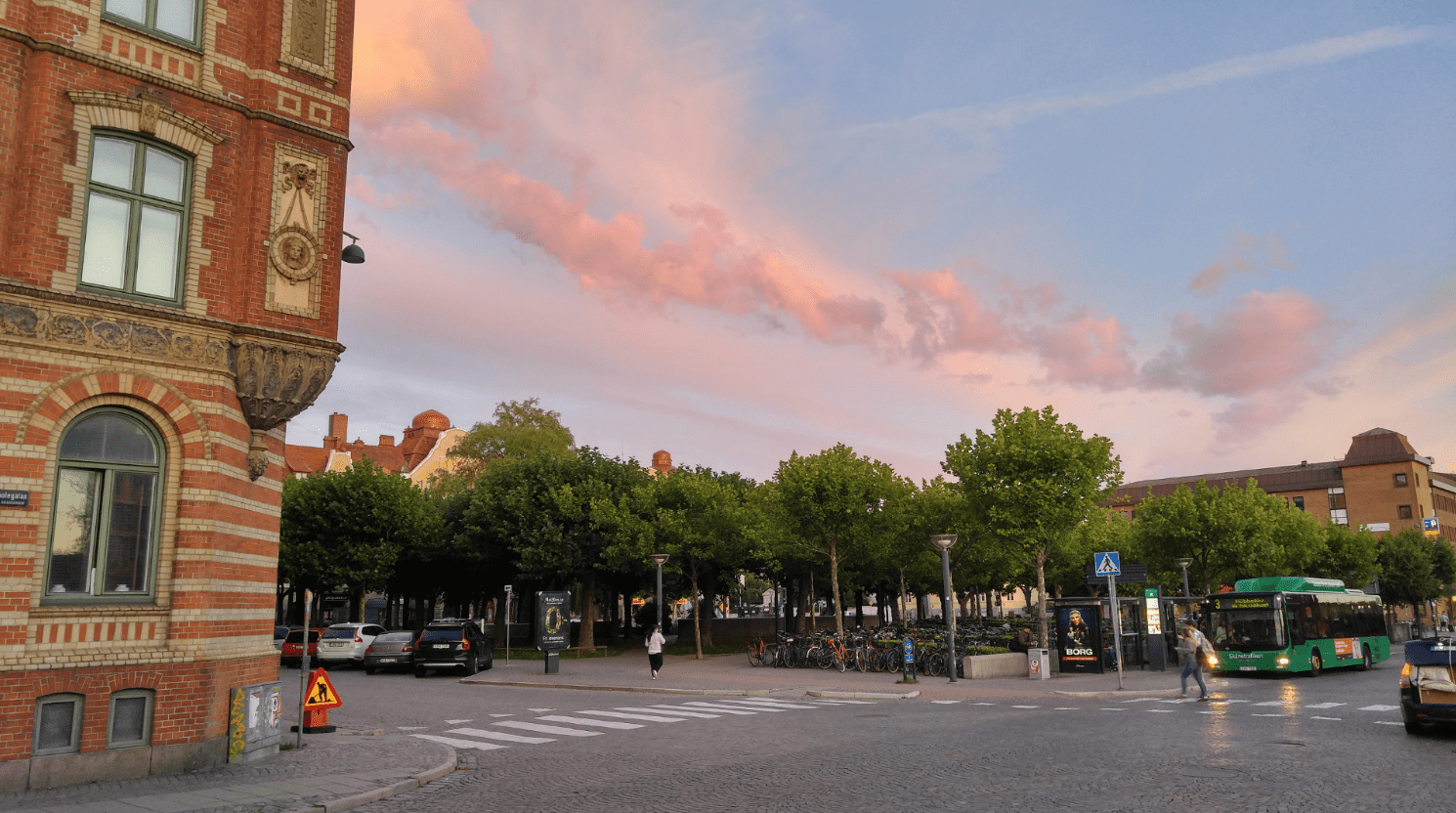
One of the first questions people ask me here in Lund is why I chose to study here. After they learn I’m from Oregon and that it took 14 hours to get here, they stare at me incredulously, as if I’m about to tell them I’m just lost, not actually supposed to be here.
I’ll generally reply by summarizing the description of Human Ecology on Lund’s website. I’ll say most universities in the U.S. don’t offer programs like that. But sometimes if people press me on it I’ll tell them I had to get out of the U.S. to escape the ideological constraints of conventional thinking there.
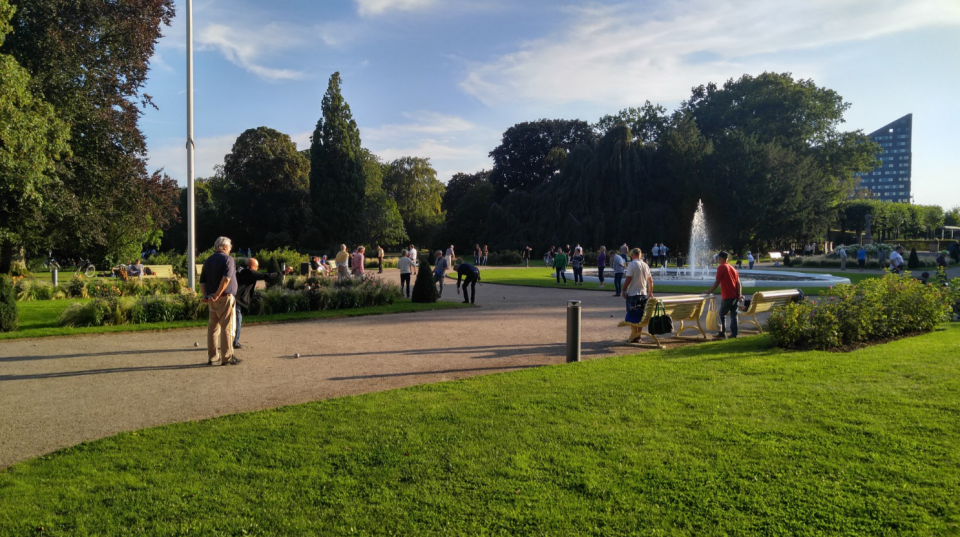
I wanted to choose a masters program that would allow me to explore the idea that protecting the environment means advancing an alternative to capitalism. I needed to think outside the box and surround myself with people who were unafraid to consider potentially controversial solutions to the environmental crisis. I needed to be somewhere where critiquing capitalism was socially acceptable.
I had plenty of graduate school options to choose from. In the United States I was accepted to Yale’s Masters of Environmental Management, University of Michigan’s Masters in Environmental Justice, and University of Montana’s Masters in Environmental Studies. I was also accepted to the University of Edinburgh in the UK and Tromso University in Norway, but none of these schools encouraged a critical analysis of capitalism as much as Lund did.
I see dismantling capitalism as a moral and existential necessity to combat environmental degradation, minimize climate change, and to achieve a socially just society. My rational hinges on three main points:
- Capitalism is inherently unsustainable. Perpetual economic growth is not possible on a finite planet, and with the impacts of climate change, deforestation, species extinction, and pollution becoming increasingly severe we need to reduce our resource use, not increase it.
- Capitalism is a racist institution that exploits black and brown communities around the world and which has done so for centuries.
- Capitalism produces massive inequality between the 1% (the capitalists, or as Bernie Sanders calls them, “the billionaire class”) and the 99%.
I see dismantling capitalism as a moral and existential necessity to combat environmental degradation, minimize climate change, and to achieve a socially just society. And as it turns out, I’m not alone.
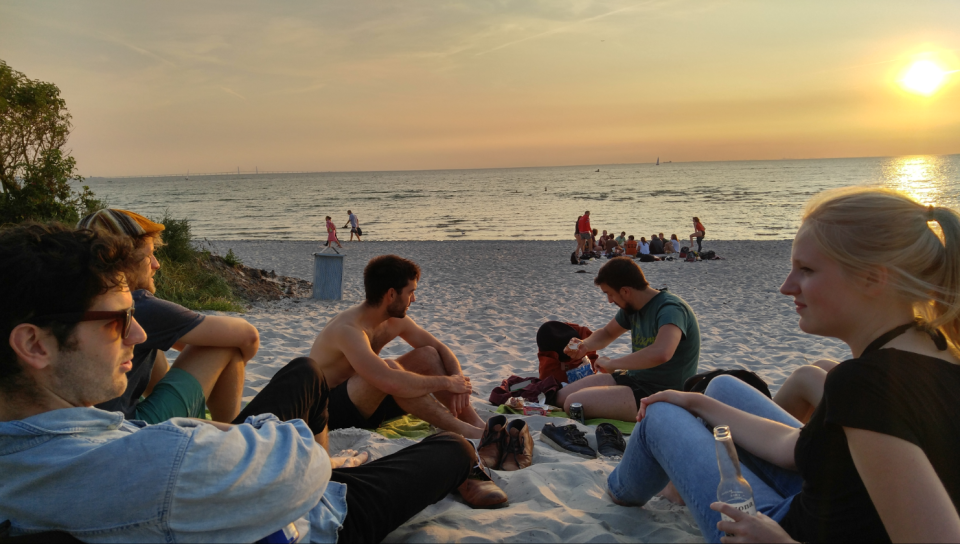
Hanging out with some classmates at Lomma Beach, Sweden
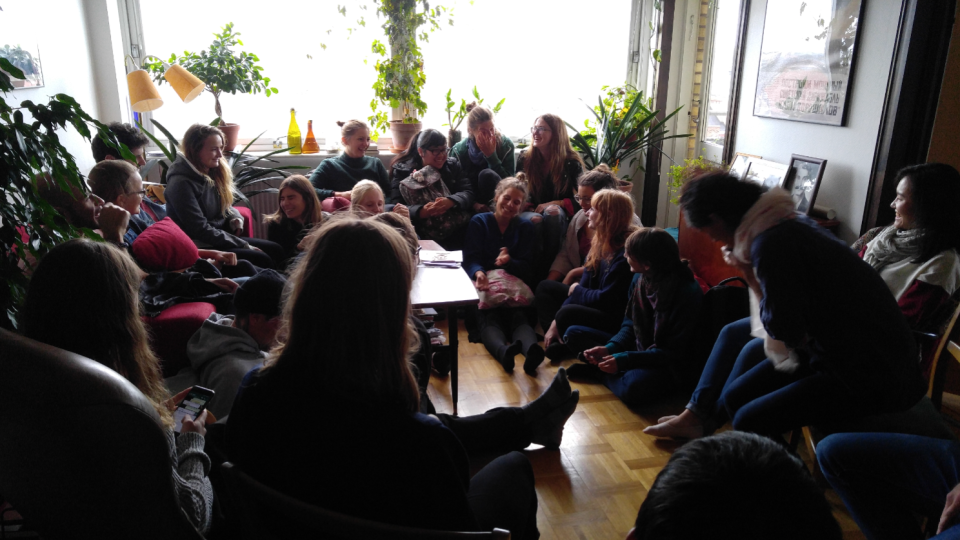
My masters program cohort and I went with our program director to his apartment in Malmo, Sweden before going out to dinner together!
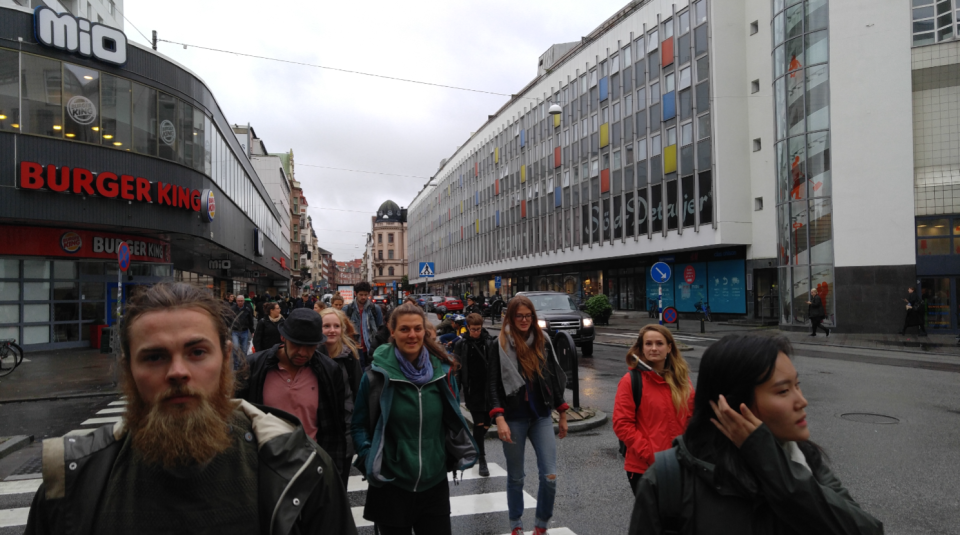
Walking to dinner in Malmo, Sweden
My first few weeks of studying Human Ecology here at Lund have offered ample confirmation of this. My peers in the program come from over a dozen countries all have studied the natural and social sciences at universities all over the world. All of us are intent on challenging the way global society thinks about sustainability. And everyone I’ve spoken with so far believes this starts by challenging the logic of capitalism.
Most of the professors in the Human Ecology program are avowed anti-capitalists and eco-Marxists. They aren’t afraid to identify capitalism as the underlying problem behind environmental problems. That is incredibly refreshing after years spent trying to justify my ideas in a business school environment. Not only that, but they’re tremendously approachable and friendly, as in Sweden the classroom is a non-hierarchical environment where professors consider their students as peers.
This kind of academic environment is just one of the reasons I feel I made the right choice coming to Sweden to study. I’ve also gotten to know my corridor-mates better over the last few weeks and we’ve started having weekly hall-dinners on Saturday nights. This last week Shu from Japan and Yun from China made Oden, a common Japanese dish made with Japanese radishes, eggs, and a variety of seafoods.
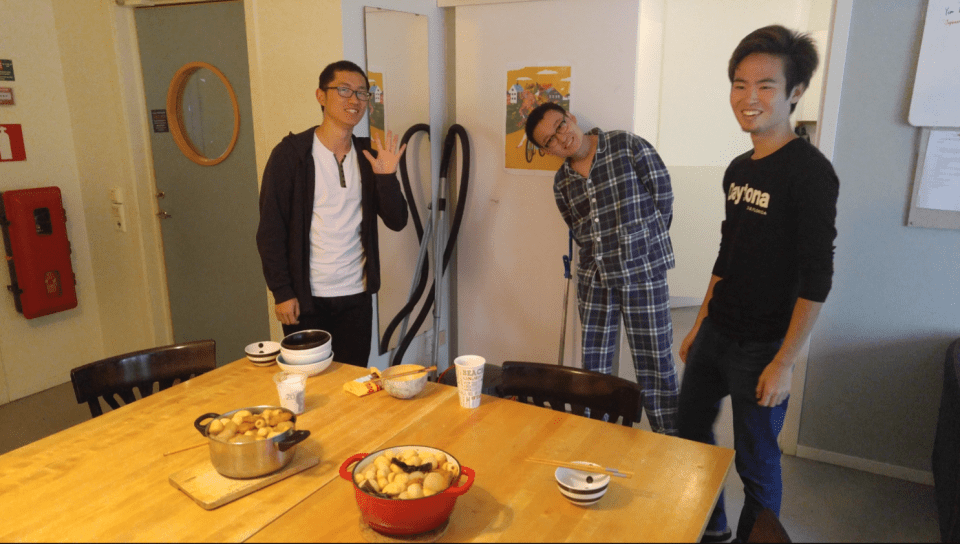
From left to right: Yun, Eric (photobombing), and Shu posing with the Oden they made!
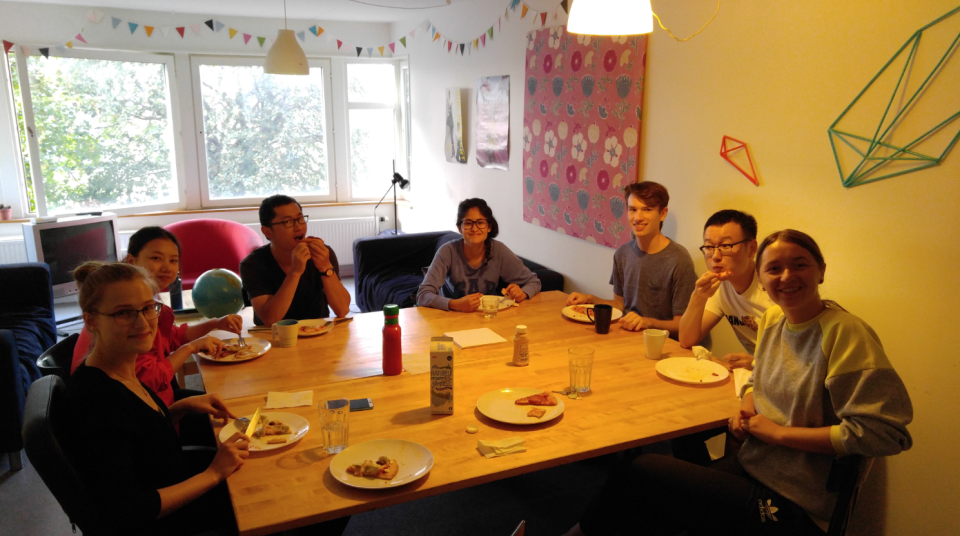
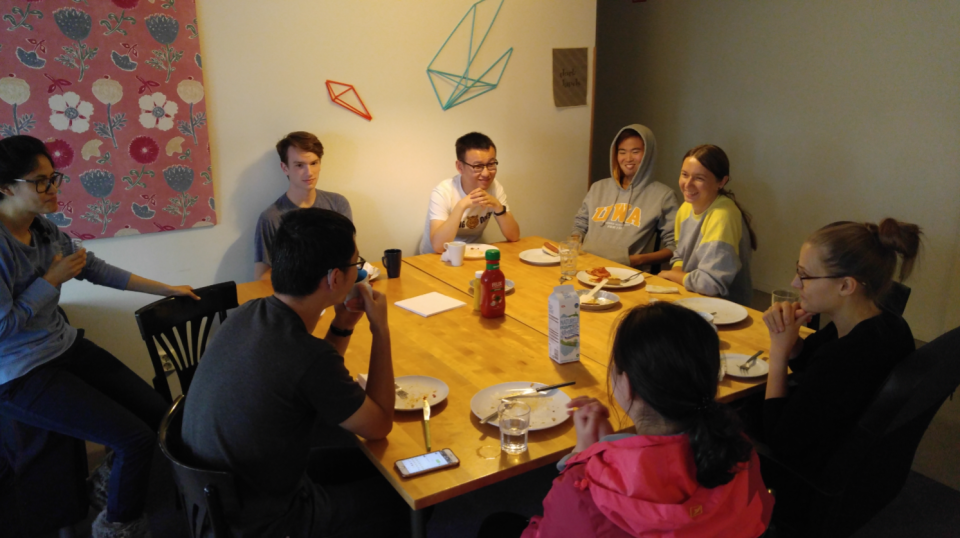
Owen (third from right) and I made homemade pizza and hotdogs for our first hall dinner on Sept 2.
I’m just now getting my feet under me, but I’m already excited to live and study with this group of global scholars for the next two years examining the unjust, unsustainable social systems of our world and figuring out how to fix them! Stay tuned!
– – – – –
Thanks for visiting aarondanowski.com! Leave you comments below, and be sure to stay up to date on my travels by clicking on the “Following” button on the right hand side of your page!
If you would like to contact me directly, please do so via email: adanowski@zagmail.gonzaga.edu


 Aaron Danowski
Great post, Aaron! Love hearing from you.
Julie McCulloh
LikeLike
You are living your dream.
Sent from my iPhone
LikeLike
As you said, a new journey has begun! Well done Son, and keep posting.
Love Mom and Dad
LikeLike
Is Eco-Marxism the solution you see to the problems of environmental degradation? Do you mean by that public ownership of the means of production and distribution across all industries (or only some industries?) If so, at what level of government would that public ownership take shape? Or do you mean stricter regulation by government (again, at what level?) aimed to reduce environmental impacts of capitalist transactions? Or am I misunderstanding completely. In the urban planning field greater good over individual benefit is often an issue that is wrestled with, with concern as to how equity is defined.
LikeLike
Hi Elizabeth, sorry I just saw this comment now! I think eco-Marxism can be useful for analyzing and critiquing the way capitalist forms of ownership are exacerbating environmental degradation. For instance, eco-Marxist John Bellamy Foster at the University of Oregon has done some really interesting research on the “metabolic rift” between rural and urban areas, with large industrial farms increasing the rate of depletion of soil fertility, transporting the embodied nutrients to urban areas, and large amounts of nutrient waste build up in population centers. And I certainly think that worker-owned cooperatives such as the Mondragon Cooperative in Spain and those in the Emilia Romagna region in Italy would help businesses pursue community wellbeing over profit maximization. However I think fundamentally you would need governments to set biophysical caps on materials in order to address the problem of over-production and ecological overshoot. That concept comes from the field of ecological economics, which is separate from eco-Marxism. These limits would likely work best if implemented at the national level, then divided up to states based on population and the kinds of throughput industries that operate there require. I think you’d also need massive government investment in renewable energy and “smart-grid” technology so that we can get off of fossil fuels, and public policy mechanisms like “community solar” programs to incentivize private/ collective renewable energy installation. One last thought specifically related to urban planning: I think a big key will be designing urban areas in such a way that you have increased population density (versus suburbs), productive capability (hydroponic farms with minimal fertilizer inputs), and community spaces (public forums, plazas, parks) so that you’re able to mend the metabolic rift and establish clusters of circular economies around the country… just a few ideas!
LikeLike