
On my journey to discover my calling and to change the world, I’ve realized that oftentimes I can’t explain why I feel so compelled to work for change. If someone inquires, I usually tell them I have a deep sense of empathy for the downcast and the oppressed, probably instilled in me by my lifelong Christian faith and my Jesuit education infused with social justice. As I’ve grown more familiar with the environmental movement in recent months, I think I’ve found a way to articulate my motivation more clearly by describing how I achieve fulfillment and wellbeing versus how society tells me I can achieve wellbeing. In the deepest fibers of my being, I believe that my wellbeing is tied to the wellbeing of not only my friends and family, but of everyone on the planet, as well as the planet itself. I feel connected to everyone, intimately related to every animal, and inextricably linked to nature itself. When a forest is clear-cut, when a species goes extinct, or when my actions (including my purchases) result in the harm or exploitation of a fellow human being, I feel like I am in a way inflicting self-harm and committing spiritual suicide.
Unfortunately, the modern world that surrounds me tells me that I am crazy for feeling this way. It labels people like me “eco-freaks,” “hippies,” and “social justice warriors,” all things which are seen as moderately derogatory. Instead of telling me everything is interconnected, modern society tells me that I am separate from every other human being, and completely separate from nature. It tells me the Earth is full of resources that I ought to harness and bend to my will, not gifts and miracles that I ought to revere as sacred. It tells me that I must compete with other people in order to earn money, gain power, or achieve status. And it tells me that only by acting out of self-interest can I protect myself from being deceived, conned, and taken advantage of. Everything society tells me hinges on my willingness to accept that I am an individual, and that self-interest and competition are the name of the game. Anyone who believes or acts differently is merely kidding themselves.
– – – – –
It hasn’t always been like this. In fact, for most of human history humanity recognized its deep connection to ourselves and the natural world around us. In many traditional cultures, concepts of a deep spiritual connection between humans and a deep bond with the wider world are commonplace. As Thomas Berry describes in his book “The Dream of the Earth,” “Our relationships with the earth [must] involve something more than pragmatic use, academic understanding, or aesthetic appreciation. A truly human intimacy with the earth and with the entire natural world is needed…. Such intimacy with the universe we find with the Omaha Indians. When a child is born, the Omaha declare its newborn presence to the entire universe. First they address the sun, the moon, the stars, and every being that moves in the heavens, declaring: ‘In your midst has come a new life. Consent ye, we implore! Make its path smooth, that it may reach the brow if the first hill.’ Then to the atmospheric world, to the winds, clouds, rain, mist, and all that moves in the air. Then to the hills, valleys, rivers, lakes, trees, and grasses. Finally, ‘Ye birds, great and small, that fly through the air. Ye animals, great and small, that dwell in the forest. Ye insects that creep among the grasses and burrow in the ground, I beg ye all to hear me. Consent ye, we implore! Make its path smooth. Then shall it travel beyond the four hills.’” (p 13-14)
Another beautiful passage from Berry’s book explains that “There is need for a great courtesy toward the earth. Such courtesy we might learn from the Iroquois. Their thanksgiving ritual is one of the most superb ceremonies that humans have ever known. Too long to present in its entirety, it does have a refrain that is relevant here: ‘We return thanks’ – first to our mother, the earth, which sustains us, then on to the rivers and streams, to the herbs, to the corn and beans and squashes, to bushes and trees, to the wind, to the moon and stars, to the sun, and finally to the Great Spirit who directs all things. To experience the universe with such sensitivity and such gratitude! These are primary experiences of an awakening human consciousness. “ (p 14)
All across Sub-Saharan Africa, the concept that human beings are all family and that we share a deep spiritual bond with one another type is referred to as Ubuntu. As one of my favorite professors at Gonzaga, Fr. Patrick Baraza, puts it, the concept of Ubuntu can be explained by the phrase “I am because we are,” or “A person is a person through other people.” Ubuntu is the very essence of collaboration and cooperation, and the very opposite of competition. It is the fundamental recognition of the duty and responsibility each person has to assure that the people around them are taken care of and respected. As Archbishop Desmond Tutu writes in his book “No Future Without Forgiveness,” “Ubuntu… speaks of the very essence of being human…. A person with Ubuntu is open and available to others, affirming of others, does not feel threatened that others are able and good, for he or she has a proper self-assurance that comes from knowing that he or she belongs in a greater whole and is diminished when others are humiliated or diminished, when others are tortured or oppressed, or treated as if they were less than who they are.”
The belief that the wellbeing of all living things are connected is shared by the cultural philosophies of the Omaha, the Iroquois, and traditional African communities across the continent. These philosophies resonate with our most authentic self, beneath the layers of cultural conditioning that we have been subjected to. Those of us who feel estranged from nature and each other in this modern world yearn for this cultural philosophy to permeate our everyday lives.
– – – – –
How did we stray away from these ancient concepts of interconnectedness and oneness with nature? Is there any hope of overcoming the self-interest omnipresent in modern society and return to a more communal notion of human existence and oneness with the earth?
To answer these questions, I find it necessary to understand the origins of self-interest and estrangement from nature, specifically in the historical roots of American capitalism and consumerism. When Adam Smith published his book The Wealth of Nations in 1776, he explained that individuals pursuing their own self-interest in a capitalist society unconsciously serve the benefit of society as a whole. Self-interested producers, he argued, will make the things that people will pay a premium to obtain, thus guaranteeing them a hefty profit for every item sold. As a result, society benefits because the unmet needs of consumers are met by the self-interested producers. When this theory is played out in real life, however, there is one major problem: although the needs of individuals are generally met, producers become greedy and seek out ways to obtain more money from consumers. This can include colluding with competitors or creating monopolies to drive up the prices of goods artificially and earn more profit for themselves. By the late 1800s, American society found itself being run by industrialists amassing huge fortunes through monopolistic or flat-out unethical business practices, such as John D. Rockefeller (Standard Oil), Andrew Carnegie (Carnegie Steel), J.P. Morgan (banking), Leland Stanford (railroads), and Henry Ford (cars). Historians would later call this period the “Robber Barron Age.”
At the turn of the 19oos, powerful industrialists and big business owners started looking for ways to increase consumers demand for products themselves. Business owners had created the infrastructure to produce massive amounts of products, but there was no way of guaranteeing there would be enough customers to buy them… unless they took drastic measures to create demand where there otherwise wouldn’t be. In a 1927 article in the Harvard Business Review, the banker Paul Mazur of Lehman Brothers described the situation by saying that “We must shift America from a needs, to a desires culture. People must be trained to desire, to want new things even before the old had been entirely consumed. We must shape a new mentality in America. Man’s desires must overshadow his needs.”
America was turned from a needs to a desires culture by Edward Bernays, the nephew of Sigmund Freud, who developed the field of public relations in the 1920s to create public desire for specific products. Bernays had previously served on the Committee on Public Information during World War I, which had been in charge of creating propaganda support the war effort. When Bernays attended the Paris Peace Conference with President Woodrow Wilson in 1919, he was shocked to see how effective their message had been: the crowds that greeted him and the President showered them with adulation and hailed them as heroes. Upon his return to the US, he set out to make his fortune by implementing this same technique for manipulating public perception in the corporate world, mainly by using his uncle’s study of psychoanalysis to pair products with people’s deep, unmet desire for power, acceptance, beauty, and so on. By 1927, public relations had become deeply engrained in the business world, so much so that one journalist wrote “A change has come over our democracy, it is called consumptionism. The American citizens first importance to his country is now no longer that of citizen, but that of consumer.”
– – – – –
The role of the individual and the ideology of big business was repressed for much of the period between the 1930s-1960s, due in part to business’ role in precipitating the Great Depression. However, big business and self-interest began to re-emerge in the 1970s. Why then? Several right wing policy think tanks, including the Heritage Foundation, the Cato Foundation, and the American Enterprise Institute, actively shifting the public discourse away from the necessity of government and towards the possibilities deregulated businesses could provide for personal wealth generation and short term economic growth. Ronald Reagan and Margaret Thatcher rose to power in the 1980s, relying heavily on reports issued by these right-wing think tanks as well as the free-market ideologies developed by economists Friedrich von Hayek and Milton Friedman. They ushered in an era of small government, deregulation, and privatization that allowed big businesses and multinational corporations (MNCs) to thrive, a philosophical movement referred to as “neoliberalism.” Communities driven by powerful communal philosophies such as the Omaha, the Iroquois, and traditional African communities are seen as threats to the neoliberal paradigm, and as such they are pressured to comply with the dominant ideology rather than express their own.
– – – – –
So, is there any hope of restructuring society around a fundamental principle of human interconnectedness and oneness with the earth? Yes! It starts by choosing to actively oppose society by changing our personal behavior, beginning with adjusting what we buy, how much we buy, and what we talk about with those close to us. It involves taking part in social action and joining interest groups opposing the destruction of nature, the extinction of species, and the harm or exploitation of fellow human beings. It means making space for indigenous communities to speak truth and wisdom into our broken society. And it means being unafraid to confront the fact that we need to open ourselves up to each other, to collaborate and love each other and grieve over the self-inflicted harm being done to us by our society.
Conventional wisdom tells us that we are foolish if we believe that cooperation is fruitful, that we only make ourselves vulnerable to pain and loss. However, our guttural instinct tells us something different. It tells us that the world is interconnected, and that our perceived individuality is an illusion make popular by our culture. It tells us that the only way to truly harm ourselves and our planet is to refuse to cooperate, and instead simply go about pursuing our own self-interest. And if we really listen closely, it tells us that we cannot be truly human unless we work to heal our broken relationships with each other, wildlife, and our planet. We all have to choose whether or not to heed this voice. What will you choose?
– – – – –
Thanks for visiting aarondanowski.com! Leave you comments below, and be sure to stay up to date on my travels by clicking on the “Following” button on the right hand side of your page!
If you would like to contact me directly, please do so via email: adanowski@zagmail.gonzaga.edu
For more on the history of PR and consumerism in the US and the UK, watch the BBC documentary series “The Century of the Self”, by Adam Curtis







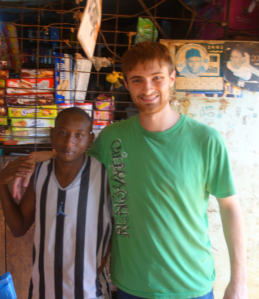 smugglers to help him reach Libya. That time, his boat successfully made it to shore in Italy, only to have the migrants apprehended by local authorities and sent back to Libya. Since then, Abdoulai has searched unsuccessfully for full-time work in Senegal, Benin, Nigeria, and Cameroon that can support his parents and elder brothers back in Senegal, but all he has managed to find is his work at the cornerstore that barely pays enough to send anything back at all. Ultimately, he finds it better to save up his money to try and make it to Italy a third time. He understands the risks, but the reward is too much to turn down: “You see two boats leave, one capsizes and everyone in it dies, but you keep going, that’s how it is… When you go live in Europe and have your papers in order, you can come back and visit your friends, but when you only spend your life in Africa its not good, you won’t have anything, just difficulties.”
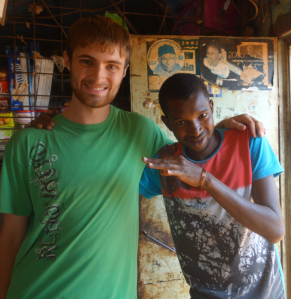 Nigeria, he managed to scrape together enough money to join a group trekking across the Nigerian border. On their journey through the forest, he told me they came across corpses, victims of Boko Haram, laying strewn on the ground. They lived in fear for several days, afraid that they would be next. Luckily, he made it safely to Yaounde, and how he is working as a shoe repairman and sending back what he can each month (he showed me the remittance transfer for November: 20,000 CFA, about $32). His ultimate goal is to save up and reach Equatorial Guinea. “They treat people very poorly over there” he tells me, “but we’re obligated to go. If that’s where I can earn a living. When your kids call you and say “we need money for food”, and when your wife and your mother say the same thing… it’s a big problem… I leave for work at 6 am and get back at 6 pm, but you know when your kids are back there, your wife is back there, you can’t just shrug your shoulders, what are they going to eat? You have to fight, and if you find a little bit, you send it back.”


 by experiencing the world from different perspectives. One of the things that attracted me to





 Abraham Maslow’s Hierarchy of Needs. In Maslow’s hierarchy, there is a natural order in which human beings are driven to fulfill our desires, starting with the basic physiological needs to eat, sleep and stay hydrated. These physiological needs, as Maslow terms them, are essential desires that help us continue to survive. As these needs are taken care of, we gradually transition towards addressing our need for safety. This need includes our desire to be free from fear, overwhelming anxiety and chaos. As we structure our environment and make sense of our surroundings, we begin to feel a strong desire for belonging, which is the basic human hunger for relationships. We strive to overcome loneliness and become part of a larger group in order to develop a sense of who we are. Next, we encounter our desire for self-esteem and respect in the eyes of others. Fulfilling our desires for achievement, independence, recognition and prestige allows us to feel valuable and important, an essential piece of being human. These four categories of needs are referred to as deficit needs, meaning that you feel the desire to fill them when they are running low. If you have enough water you simply say you “Don’t feel thirsty”. If you feel secure, chances are you won’t think to yourself how nice it is to be safe. In this way, as you satisfy these needs, you return to an equilibrium rather than experiencing a psychological high. Typically you don’t feel any lasting sense of wellbeing after gratifying these needs, just the emergence of the next level of need.
 fulfillment. This is the epitome of humanness, attaining one’s potential by fully expressing oneself. Maslow estimated that only about 2% of people achieve this level of needs gratification. Since self-actualization is conditional upon the fulfillment of one’s lower level needs, our ability to achieve this level of humanness is inextricably tied to the health of our ecosystem. If our ecosystem provides us with the opportunity to seek information, speak freely, express ourselves and do whatever we want without hurting others, the odds of being able to self-actualize grow larger. Since this is the case, many people are not able to self actualize due to the conditions of their environment, not because of their lack of willpower or effort. A young Syrian girl in a refugee camp in Turkey stands little to no chance of achieving her full potential, while her counterpart in suburban Ohio who has strong support from her family, her community and the broader society in the form of public services has much more control over her ability to self-actualize.
 analyze the issue. The fundamental problem with our current economic model is that we’ve convinced ourselves that money is the end goal: it can buy happiness, and accumulating it gives us access to the things that fulfill our desires. I know that sounds like a broken record, we tell ourselves all the time that money isn’t the key to happiness, but do we live that out? Lets do a quick experiment: Watch these three advertisements and count how many times you see something other than the products delivering happiness:
 Economy


 Aaron Danowski
Recent Comments